By Shreyas Ramachandran Srinivasan
I see you, I hear you
A Mental Health Art Week 2026 workshop by Giulia Lepori
I see you, I hear you workshop
The first thing we were asked to do was choose a piece of artwork that resonated with us.
The room fell silent as everyone walked around studying the images.
I found myself drawn to a picture of children fishing by the shore under bright sunlight. What stood out to me wasn’t the fishing. It was how visible they seemed. Open. Unafraid of being seen.
It reflected something I wanted for myself but hadn’t fully reached yet.
From there, we moved into a series of improvisation exercises. We mirrored each other’s movements, played different characters, and communicated using only numbers instead of words. Without realizing it, we stopped focusing on what to say and started paying attention to expression, body language, and emotion.
Something shifted.
The activities felt playful on the surface, but underneath they encouraged us to reconnect with parts of ourselves that adulthood often teaches us to hide.
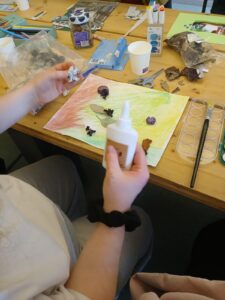
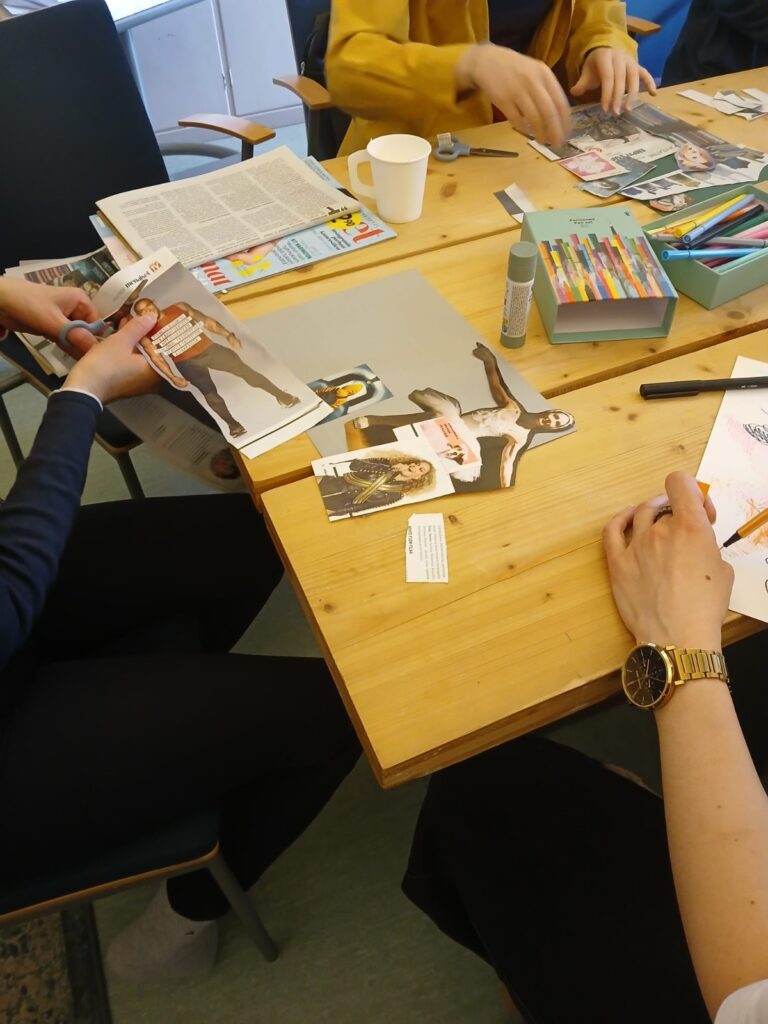
Then came what I can only describe as a buffet of creativity. Paints, papers, markers, fabrics, and craft materials covered the tables, inviting us to create something connected to the theme we had chosen at the beginning.
The artwork I created was called “From Shadow Into Bloom.”
At its center is a dark shadow pierced by a knife. Surrounding it are colorful butterfly wings representing the people who support me. In the piece, those wings help lift me from darkness into colour, from hiding into expression.
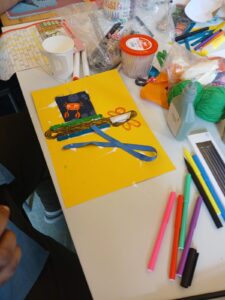
When it came time to create our artwork, I found myself drawn less to drawing and more to assembling. I picked up different materials from the table, ribbons, popsicle sticks, fabric, colours, and glue, and started putting them together without a clear plan. The process felt instinctive rather than deliberate.
As I looked at the finished piece afterwards, I realized that what I had created wasn’t really a picture. It was a collection of fragments brought together into something meaningful.
There was a small orange figure placed on a dark piece of fabric. Although it was one of the smallest elements in the artwork, it immediately drew attention because of the contrast. Looking back, it felt like a representation of a part of myself that wanted to be seen. A quieter voice that often exists in the background but still hopes to be noticed and understood.
What struck me most was how the artwork mirrored the workshop itself. Human beings are not made of one thing. We are made up of experiences, relationships, memories, dreams, fears, successes, and disappointments. None of these pieces tell the whole story on their own. It is only when they come together that they form something recognizable.
The workshop felt similar. A room full of strangers arrived carrying their own stories, hopes, and uncertainties. Through movement, improvisation, conversation, and art, those individual pieces slowly came together to create a temporary community.
After everyone had finished their artwork, we gathered together and shared what we had created. One by one, participants spoke about the stories behind their pieces. Some stories carried grief. Others carried hope, resilience, joy, or uncertainty. What mattered was that each person was given space to be heard.
By the end, I left with a realization that felt fitting for a workshop called “I See You, I Hear You.” Being seen and heard is perhaps not about showing a perfect version of ourselves. It is about allowing others to see the unfinished collage we really are.
This participatory workshop focused on human connection through gentle movement, playful improvisation, and creative expression. Participants were invited into a non-judgmental space where listening, presence, and authentic interaction were at the center. Through a series of interactive activities, the workshop encouraged people to connect with themselves and others beyond words, creating opportunities to be seen, heard, and understood in a supportive environment.
Final Reflection
Before attending these workshops, I thought Mental Health Art Week would primarily be about creating art.
Instead, I found myself exploring questions like…
- What does belonging look like when you’re still learning the language of a community
- What feeds growth when the future feels uncertain?
- What happens when we allow ourselves to be seen and heard without having all the answers?
Across the three workshops, I noticed a common thread. None of my creations felt finished.
In The Loom of Belonging, I found myself sketching motifs and leaving large spaces empty as I explored a symbolic language that was completely new to me.
In NeuroTree, I drew roots, branches, and fruits representing my aspirations, but it was the empty space around the tree that reminded me of everything I cannot yet predict about my future.
In I See You, I Hear You, I assembled fragments of different materials into an artwork that reflected how people themselves are often collections of experiences, relationships, hopes, fears, and unfinished stories.
At first, I thought these unfinished elements were flaws. Now I see them differently.
The empty spaces in the motifs, the uncertainty around the tree, and the fragments within the collage all reflected where I currently am in life. Graduating. Looking for work. Building community. Learning how to belong. Learning how to express myself in new ways.
Perhaps mental wellbeing is not always about finding answers. Perhaps it is about creating spaces where questions can exist without needing immediate resolution.
What I appreciated most about these workshops was that they provided exactly that kind of space. A space where people from different backgrounds could explore, create, reflect, and share parts of themselves without judgement. Some participants found hope. Others found relief. Some found joy. I found curiosity.
And sometimes curiosity is enough.
Because curiosity keeps us open to new people, new perspectives, new possibilities, and new versions of ourselves.
I arrived expecting to make art.
I left with a deeper appreciation for the value of exploration, connection, and the courage it takes to share an unfinished story.